Skip to content

Best Extra Thick Exercise Mats for Pain-Free Floor Workouts
·16 min read·by
Best Extra Thick Exercise Mats for Pain-Free Floor Workouts

The best best extra thick exercise mats for floor workouts for most people is the CAP Barbell All Purpose Folding Anti mat, and the case for it is straightforward. It clocks in at 2 inches (about 5 cm) of anti-tear foam, it folds into a stack instead of rolling into a log, and its reported rating sits at 4.7 out of 5.

Want maximum cushioning instead? The 3 Inch Thick Yoga Mat 72 delivers triple the loft, as long as you accept a heavy mat that squishes under balance work.

As an Amazon Associate, I earn from qualifying purchases.

Below you'll also see the buyers this category fails, because a thick mat is a bad purchase for anyone who needs to carry it to a class or roll it into a bag.

Everything here comes from current Amazon listing specs and each product's owner track record, not lab testing. Here's the team behind these picks and how we put a list together.

Quick Answer: The Best Extra Thick Exercise Mats for Floor Workouts

Our top pick is the CAP Barbell folding mat, because 2 inches of foam plus a four-panel fold solves both comfort and storage in one purchase.

Thinking about a travel mat or a rubber gym floor setup instead? Jump to Who Should NOT Buy below before you spend anything.

Comparison Table

Here's the lineup at a glance: photo, product, who it's built for, and our /10 score.

PhotoProductBest forScoreBuy
CAP Barbell All Purpose Folding AntiCAP Barbell All Purpose Folding AntiEveryday floor workouts9.0/10Check price →
3 Inch Thick Yoga Mat 723 Inch Thick Yoga Mat 72Maximum joint cushioning8.4/10Check price →
CAP Barbell All Purpose Folding AntiCAP Barbell All Purpose Folding AntiTight rooms and dorms8.8/10Check price →
Amazon Basics Extra Thick Exercise YogaAmazon Basics Extra Thick Exercise YogaFirst mat on a budget8.3/10Check price →
Retrospec Solana Yoga Mat Extra ThickRetrospec Solana Yoga Mat Extra ThickSweaty grip, class travel8.6/10Check price →

Scroll sideways on small screens to see every column.

CAP Barbell All Purpose Folding Anti: Best Overall for Floor Workouts

#1CAP Barbell All Purpose Folding Anti
CAPFolds flat, 2-inch cushion
9.0OUT OF 10
Cushion & Support9.2
Grip & Stability8.8
Portability9.1
Owner Verdict9.0
**This is the pick for anyone who trains on a hard floor more days than not.** The CAP Barbell All Purpose Folding Anti mat is 2 inches (about 5 cm) thick in an anti-tear foam, which is enough loft to soften planks, hip bridges and seated core work over tile or concrete. Its reported rating is 4.7 out of 5, and the recurring note in verified feedback is that it keeps its shape instead of flattening out after a few weeks.
The four-panel fold is the practical part. Rather than wrestling a rolled mat into a corner, you fold it into a stack that slides under a bed or stands against a wall, and the hinge lines sit flat enough that knees don’t catch on them. Reviewers using it for stretching, bodyweight circuits and kids’ tumbling report it staying put on carpet without skating across hardwood.
**Flaws but not dealbreakers.** This is not a mat you carry to a studio. Folded, it is bulky, and the listing doesn’t include a strap, so it tends to live where you use it. A few buyers also mention a faint foam smell in the first few days that fades once it airs out.
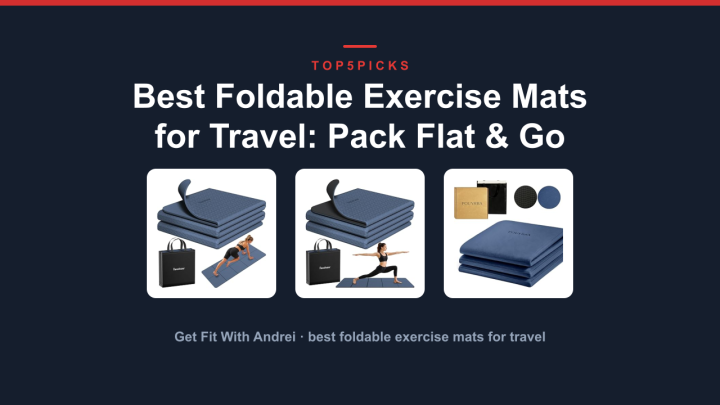
If a lighter mat you can roll and travel with matters more, the Amazon Basics Extra Thick Exercise Yoga Mat further down ships with a carrying strap and rolls tight.
⚠
Care: Wipe it with warm water and mild soap rather than an alcohol spray, since solvents dry out the foam surface. Let it air flat before folding it back up.
Pros
  • ✓2-inch (5 cm) foam depth takes pressure off knees and elbows
  • ✓Four-panel fold stores flat under a bed or against a wall
  • ✓Anti-tear surface rated for repeated folding and dragging
  • ✓4.7/5 reported rating with consistent shape-retention feedback
Cons
  • ✕Bulky when folded and no carry strap in the box
  • ✕Faint foam odour on arrival reported by some buyers
  • ✕Not the pick if you need one mat for studio classes too
Thickness
2 in (5 cm)
Surface
Anti-tear foam
Footprint
Multiple sizes
Storage
Folds flat
Best for: Daily planks, core work, stretching and bodyweight circuits on tile, concrete or hardwood, especially when the mat needs to disappear between sessions.

3 Inch Thick Yoga Mat 72: Best for Maximum Cushioning

#23 Inch Thick Yoga Mat 72
33 inches of foam, 72-inch length
8.4OUT OF 10
Cushion & Support9.4
Grip & Stability7.4
Portability7.2
Owner Verdict9.6
**Buy this one if your knees, hips or tailbone complain on a thinner mat.** At 3 inches (7.6 cm) of foam across a 72 x 32-inch surface, it’s the deepest cushion in this lineup and the longest, which means taller users get full head-to-heel coverage without their feet hanging off the end.
That loft pays off most in floor-based routines: bird dogs, glute bridges, side-lying leg work, and any pose where a bony joint presses down. It’s also a genuinely useful surface for physical-therapy-style movements at home, which is why the reported 4.4 out of 5 rating leans heavily on older knees and post-injury users.
**Flaws but not dealbreakers.** At this depth the foam compresses under a single leg, so one-legged balances and standing poses wobble. It’s also a big piece of kit to roll, store and carry, and taller stacks like this tend to shed a little material at the edges over months of folding.
If you want dependable traction plus a mat you can actually sling over your shoulder, the Retrospec Solana later in this list trades loft for a grippier 1-inch surface and a strap.
⚠
Stability: Deep foam moves under you, so skip this mat for single-leg balances and standing postures. It’s built for seated, supine and kneeling work.
Pros
  • ✓3-inch (7.6 cm) foam depth is the thickest cushion here
  • ✓72 x 32-inch surface suits taller users and full-body floor work
  • ✓Reported 4.4/5 rating with strong feedback from joint-sensitive users
  • ✓Non-slip textured top helps on carpet and low-pile rugs
Cons
  • ✕Too soft for balance poses and single-leg work
  • ✕Bulky to roll and store, and heavier than a standard mat
  • ✕Edge wear reported after months of folding on some units
Thickness
3 in (7.6 cm)
Surface
Non-slip foam
Footprint
72 x 32 in
Storage
Rolls, bulky
Best for: Anyone with tender knees, hips or spine who wants the softest landing available for Pilates, stretching and rehab-style floor drills at home.

CAP Barbell All Purpose Folding Anti: Best for Small Spaces

#3CAP Barbell All Purpose Folding Anti
CAPSame 2-inch foam, smaller floor space
8.8OUT OF 10
Cushion & Support9.0
Grip & Stability8.7
Portability9.0
Owner Verdict8.5
**This is the version to buy when your training space doubles as your living space.** It’s the same CAP Barbell build as our top pick, still 2 inches thick in anti-tear foam, but it’s the smaller of the two configurations, so it opens up to a workable pad and then folds down into a compact panel stack.
That matters in apartments, dorm rooms and bedrooms where a permanently unrolled mat would eat the floor. Verified buyer feedback on this size leans on the same strengths as its bigger sibling: it holds shape, it stays put, and the fold lines don’t create bumps under your spine. The reported 4.7 out of 5 rating holds here too.
**Flaws but not dealbreakers.** A smaller mat means less runway for wide stretches, and tall users doing full-body supine work will find their heels or shoulders close to the edge. It also doesn’t come with a strap, so it stays home. If you’re building a floor routine around resistance work too, our guide to compact weights that fit tight corners pairs well with this footprint.
For a longer surface at the same thickness, the larger CAP Barbell fold mat at the top of this list gives you the same foam with more room to spread out.
⚠
Sizing: Check the dimensions on the listing before you buy, because this listing covers several sizes and colours under one title. Measure your floor space first so you don’t end up with less mat than your routine needs.
Pros
  • ✓2-inch (5 cm) anti-tear foam at the smaller footprint
  • ✓Folds into a slim panel stack for closets and under beds
  • ✓Reported 4.7/5 rating with strong shape-retention feedback
  • ✓Hinge lines lie flat enough for floor work and crunches
Cons
  • ✕Shorter surface limits wide or fully extended stretches
  • ✕No carry strap included, so it’s a stay-at-home mat
  • ✕Multiple size and colour options can make ordering confusing
Thickness
2 in (5 cm)
Surface
Anti-tear foam
Footprint
Compact config
Storage
Folds flat
Best for: Apartment dwellers, students and anyone whose workout area has to convert back into a bedroom the moment the session ends.

Amazon Basics Extra Thick Exercise Yoga: Best Value for Beginners

#4Amazon Basics Extra Thick Exercise Yoga
AmazonRolls up, strap included
8.3OUT OF 10
Cushion & Support8.0
Grip & Stability8.4
Portability9.2
Owner Verdict7.6
**If you’re buying your first mat and don’t want to spend much, start here.** The Amazon Basics Extra Thick Exercise Yoga Mat is the simplest thing in this lineup: a dense foam pad with a textured surface and a carrying strap in the box. Its reported rating sits at 4.6 out of 5, which is remarkable for a budget product with this many buyers behind it.
It’s the most travel-friendly option here. It rolls tight, it’s light enough to sling over a shoulder on the walk to a class, and the strap means you’re not hunting for a bungee cord the day it arrives. For a beginner doing abs, stretching and light yoga in a living room, it covers the basics without fuss.
**Flaws but not dealbreakers.** It isn’t a thick mat in the way the others here are. The foam is dense but shallow compared to a 2-inch or 3-inch pad, so if your discomfort is sharp pressure on a hip bone or tailbone, this won’t be enough. Some longer-term owners also report the surface losing a bit of grip as it breaks in.
When pressure on joints is the real problem, step up to the compact CAP Barbell folding mat, which adds roughly four times the foam depth.
⚠
Care: Roll it with the textured side facing out and store it away from direct sun, since UV exposure degrades foam over time. A damp cloth is all it needs after a sweaty session.
Pros
  • ✓Dense extra-thick foam at a budget-friendly price point
  • ✓Carrying strap included, so it travels straight out of the box
  • ✓Reported 4.6/5 rating across a very large buyer base
  • ✓Light enough to roll tight and take to a studio class
Cons
  • ✕Shallower than the 2-inch and 3-inch picks on this list
  • ✕Grip can fade as the surface breaks in, per long-term owners
  • ✕Not enough cushioning for sharp hip or tailbone pressure
Thickness
Extra thick foam
Surface
Textured foam
Footprint
Standard mat
Storage
Rolls + strap
Best for: Beginners, teens and casual exercisers who want one dependable mat with a strap, without spending much to find out if a home routine sticks.

Retrospec Solana Yoga Mat Extra Thick: Best Grip for Sweaty Sessions

#5Retrospec Solana Yoga Mat Extra Thick
Retrospec1-inch textured grip, strap included
8.6OUT OF 10
Cushion & Support8.5
Grip & Stability9.3
Portability8.4
Owner Verdict8.2
**Pick this one when your hands and feet slide before your muscles get tired.** The Retrospec Solana Yoga Mat Extra Thick is 1 inch (2.5 cm) deep, and that middle ground is exactly why it works: enough foam to protect knees and forearms, not so much that you’re standing on a sponge. It ships with a strap and its reported rating is 4.5 out of 5.
The textured surface is the standout. Verified buyer reviews repeatedly mention holding traction through hot yoga and long plank holds, which is where thinner budget mats usually fail. It’s also the easiest of the thicker picks to carry, so it suits a home routine plus a weekly class.
**Flaws but not dealbreakers.** A textured top needs more cleaning than a smooth one, because sweat and dust settle into the pattern. Some buyers also report a rubbery scent for the first week, and the 1-inch depth still compresses under a single knee, so it’s not a substitute for a 2-inch or 3-inch pad.
If deep cushioning matters more than grip, the 3-inch yoga mat above gives you triple the loft at the cost of stability.
⚠
Care: Clean the textured side after every sweaty session, since body oils clog the pattern and cut grip over time. Air it flat rather than rolling it damp.
Pros
  • ✓1-inch (2.5 cm) foam balances cushioning with stability
  • ✓Textured surface holds grip through sweaty sessions
  • ✓Carrying strap included for class or travel use
  • ✓Reported 4.5/5 rating with consistent traction feedback
Cons
  • ✕Textured top needs frequent cleaning to keep its grip
  • ✕Rubbery smell reported for the first few days
  • ✕Still compresses under a single knee at 1-inch depth
Thickness
1 in (2.5 cm)
Surface
Textured grip
Footprint
Standard mat
Storage
Rolls + strap
Best for: Sweaty sessions, hot yoga, plank-heavy circuits and anyone who wants one mat that works at home and travels to a class.

Buying Guide: Thickness, Grip, Storage and Your Base Floor

Thickness is the spec everyone shops on and the one most likely to disappoint. Here's how to read it before you buy.

How Thick Should an Exercise Mat Actually Be?

A thick exercise mat is a foam pad that spreads your body weight across a wider area so hard floors stop pressing into joints. For floor-based work, 1 inch (2.5 cm) is the practical minimum for comfort and 2 to 3 inches (5 to 7.6 cm) is where real relief starts.

The catch is that more foam means less stability. Foam compresses under load, so a 3-inch pad wobbles in a single-leg balance while a 1-inch pad holds firm. Buy depth for the work you actually do, not the number that sounds best.

Why Does Foam Density Matter More Than Thickness?

Thickness tells you how far you sink; density tells you whether the foam springs back. A thin but dense pad can outperform a thick spongy one over a year of daily use.

This is why the reported owner ratings in this lineup hold up. The CAP Barbell picks use an anti-tear foam and both sit at 4.7 out of 5, with shape retention as the most common praise. Cheap low-density foam flattens into a permanent dent within months.

Grip, Surface Texture and Your Floor Type

Grip comes from two places: the texture under your hands, and the friction between the mat's base and your floor. A textured top like the Retrospec Solana keeps traction when palms get damp, which matters in any routine with plank holds or downward-facing work.

Smooth foam slides more readily, especially on hardwood and laminate. Over carpet, almost everything stays put. The rougher your floor is, the more you can rely on the base to do the gripping for you.

Storage: Fold, Roll or Leave It Out

This is the decision factor buyers regret most often. A mat you can't store is a mat you stop using.

Foldable panels, like the ones on the full-size CAP Barbell mat, stack flat and slide under a bed. Rolled mats take up a column of space but travel easily with a strap, which is why the Amazon Basics option suits mixed home-and-class use. Measure your storage spot first, then pick.

Physical activity guidelines from the Centers for Disease Control and Prevention call for at least 150 minutes of moderate movement a week, and a mat that's awkward to set up is one of the quiet reasons people fall short. If discomfort is derailing your sessions, our roundup of common training trouble spots is worth a read. For joint pain that persists, the National Institute of Arthritis and Musculoskeletal and Skin Diseases has plain-language guidance on when soreness needs a professional look.

Amazon Basics 1/2-Inch Extra Thick Exercise Yoga Matvia Ballin’ Under Budget

Who Should NOT Buy Best Extra Thick Exercise Mats for Floor Workouts

This category is the wrong purchase for three kinds of buyers. Here's who they are, and what to look at instead.

You Need to Carry It in a Backpack or Bike Bag

A 2-inch or 3-inch mat is heavy and awkward, no matter how tightly you roll it. Folding helps at home but adds bulk, since fold lines need thicker panels to hold shape.

If portability is the priority, look at a travel mat around 1 to 3 mm thick. You give up every bit of joint cushioning, but it fits in a bag and you'll actually take it with you.

You Do Balance Work or Standing Poses

Deep foam is a bad partner for single-leg work. Your ankle and knee make constant micro-corrections on a soft surface, which makes balance harder rather than training it.

For yoga flows, balance postures and standing work, choose a firm mat under 6 mm or a cork-topped surface. Keep a thick pad separate for the floor-based portion of your routine.

You Have an Actual Injury or Ongoing Pain

No mat treats a joint problem. Cushioning reduces pressure, but it won't fix a torn meniscus, sciatica or a disc issue.

If pain shows up during or after exercise, get it assessed before you shop for gear. A mat is a comfort purchase, and it should never be the first line of defence.

Final Verdict

For most people with a hard floor and a home routine, the CAP Barbell All Purpose Folding Anti mat is the straightforward answer. Two inches of anti-tear foam, a 4.7 out of 5 reported rating, and a fold that gets it out of your living space in seconds.

Want maximum cushioning instead? Get the 3 Inch Thick Yoga Mat 72. It's the softest landing here across a 72 x 32-inch surface, as long as you accept that balance poses will feel wobbly.

Short on floor space? The compact CAP Barbell fold mat keeps the same 2-inch foam in a smaller footprint. And if grip through sweaty sessions matters most, the Retrospec Solana is the one to grab.

One last thing before you add anything to your cart: if you're a balance-focused yogi, a backpack commuter or someone with an undiagnosed injury, the Who Should NOT Buy section above applies to you. For everyone else on a hard floor, one of these five will do the job for years.

The Top 5 Best Exercise Mats in 2026 – Must Watch Before Buying!via Top 5 Choice

FAQ

What's the best extra thick exercise mats for floor workouts overall?

The CAP Barbell All Purpose Folding Anti mat, because 2 inches of anti-tear foam covers planks, core work and stretching while the four-panel fold lets it disappear between sessions. It carries a reported 4.7 out of 5 rating.

Are extra thick mats bad for yoga?

They're bad for standing poses and balance work, not for yoga as a whole. At 2 to 3 inches the foam compresses unevenly under one leg, so seated, supine and kneeling poses feel great while standing postures feel unstable.

How do I stop a thick mat from sliding on a hard floor?

Check that the base is clean and dry, and avoid polishing the floor right before you train. If it still creeps, a thin rubber rug pad underneath adds friction without changing the cushioning you bought the mat for.

Is 1 inch thick enough for a home workout?

For most bodyweight floor work, yes. One inch (2.5 cm) cushions forearms, knees and hips during planks, crunches and stretching, and it stays stable enough that you don't feel like you're balancing on a mattress.

Should I buy a folding mat or a rolled one?

Buy folding if the mat lives in one room and needs to vanish into a closet or under a bed. Buy rolled if you ever carry it to a class, since a strap makes a rolled mat far easier to transport than a panel stack.

How do I clean a thick foam exercise mat?

Wipe it with warm water and a drop of mild soap, then let it air dry flat before storing it. Skip alcohol and harsh sprays, since they dry out foam and shorten its life. Full details sit in our site's health and fitness notes.

Share.

Similar Posts

Leave a comment

Your email address will not be published. Required fields are marked with an asterisk.

Best Waterproof Timers for Cold E…Best Digital Water Thermometers f…Top Ice Bath Thermometers With La…Best Insulated Cold Plunge Tubs f…Best Cold Therapy Wraps for Elbow…Best Quick-Drying Cooling Towels …Stay Cool: Best Portable Cooling …Best Reusable Ice Packs for Post-…Best Reusable Hot & Cold Pac…Best Quick-Drying Microfiber Towe…
Share