Best Muscle-Building Meal Prep Containers for Gains
The short answer on the best meal prep containers for muscle building diets: the 50 (100-Piece) 32 oz Meal Prep set takes it, because it's the only option here that hands you 50 single-compartment containers at a full 32 oz each. That's a week of prepped chicken, rice and veg without washing a tub mid-week. It suits lifters eating in a calorie surplus who need volume, not fiddly dividers.
Want glass instead of plastic? The KOMUEE 10 Packs 30 oz Glass gets you there, as long as you're fine with 10 containers and the extra weight in your gym bag.
As an Amazon Associate, I earn from qualifying purchases.
This guide covers what the other roundups skip: real portion math, how the lids actually behave, and which buyers should walk away entirely. If you eat out most weekdays or you're cutting on tiny portions, this category will sit unused in your cupboard.
One honesty note before you scroll. Everything below comes from current Amazon product data, listed specs and each set's owner track record, not hands-on lab testing. We're the team behind these guides, and you can read how we handle commissions any time.
Quick Answer: The Best Meal Prep Containers for Muscle Building Diets
The 50 (100-Piece) 32 oz Meal Prep set wins on sheer usable volume: 50 containers, 32 oz each, easy-open lids that don't fight you at 6am.
- 50 (100-Piece) 32 oz Meal Prep (Best overall for volume): 50 containers at 32 oz each with quick easy-open lids.
- Bentgo Prep Meal Containers Lids (Best recognised brand): PFAS-free and BPA-free 20-piece set that stacks neatly in the fridge.
- KOMUEE 10 Packs 30 oz Glass (Best glass pick): Ten 30 oz glass tubs that won't stain or hold smells.
- Freshware 2 Compartment Food Storage Containers (Best for macro splitting): Two-zone 28 oz tubs that keep protein and carbs apart.
- Glotoch 50 Pack(100-Piece)32oz 2-Compartment Meal Prep (Best budget bulk): Fifty 32 oz two-compartment containers for the lowest cost per meal.
Thinking about disposable trays or one fancy lunchbox instead? Jump to Who Should NOT Buy below before you spend anything.
Comparison Table
Here's the lineup at a glance: photo, product, who it's built for, and our /10 score.
| Photo | Product | Best for | Score | Buy |
|---|---|---|---|---|
 | 50 (100-Piece) 32 oz Meal Prep | High-volume weekly meal prep | 9.1/10 | Check price → |
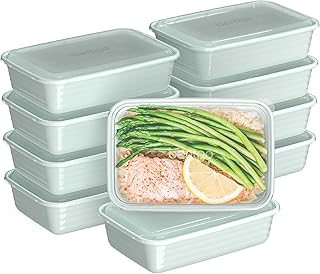 | Bentgo Prep Meal Containers Lids | Brand-name PFAS-free plastic | 8.6/10 | Check price → |
 | KOMUEE 10 Packs 30 oz Glass | Reheating without plastic | 8.9/10 | Check price → |
 | Freshware 2 Compartment Food Storage Containers | Splitting protein and carbs | 8.2/10 | Check price → |
 | Glotoch 50 Pack(100-Piece)32oz 2-Compartment Meal Prep | Budget bulk two-zone prep | 7.4/10 | Check price → |
Scroll sideways on small screens to see every column.
50 (100-Piece) 32 oz Meal Prep: Best Overall for High-Volume Prep
Bentgo Prep Meal Containers Lids: Best Brand-Name Set
KOMUEE 10 Packs 30 oz Glass: Best Glass Option
Freshware 2 Compartment Food Storage Containers: Best for Macro Splitting
Glotoch 50 Pack(100-Piece)32oz 2-Compartment Meal Prep: Best Bulk Budget Pick
Buying Guide: Capacity, Compartments, Material and Durability
How Much Capacity Do You Actually Need?
Start with the math. A muscle building plate usually runs 6 to 8 oz of cooked protein, a cup or two of rice or potatoes, and a fistful of vegetables. That's roughly 24 to 32 oz of food per sitting, which is why the 30 oz and 32 oz sets here beat every 20 oz tub on the market.
If you eat five meals a day, five containers per day is your baseline. A 50-piece set covers a full week with spare tubs for travel days. A 10 or 15-piece set covers two to three days and expects you to wash mid-week.
The KOMUEE 30 oz glass tubs sit right at the useful edge: big enough for a real bodybuilding portion, small enough to fit a standard work fridge shelf.
Do Dividers Help or Hurt?
Compartment count is a personal-habit decision, not a quality one. Dividers help if you're tracking macros visually, because protein and carbs stay physically apart. The Freshware two-zone tubs are built for exactly that.
Here's the trade-off. A divider eats interior volume and blocks bulky meals. A whole sweet potato or a full burrito bowl simply won't sit flat in a split tub.
Single-compartment containers handle anything but mix everything into one pile.
Ask yourself one question: do I plate my food as separate components, or do I stir it together? If it's the latter, skip compartments entirely.
Plastic, Glass, or Something Else?
Plastic keeps the cost down per container and survives drops. It also stains, holds onto strong spices, and flexes under heat over years of use. Most sets are top-rack dishwasher safe, and none of these should go near a grill or open flame.
Glass wins on cleanliness and reheating confidence. It doesn't stain, doesn't absorb odors, and works in the oven as well as the microwave. The cost is weight: a full 30 oz glass tub is heavy in a backpack, and one hard knock on tile can end it.
There's also a chemical angle worth knowing. BPA is a known endocrine-active compound, which is why the National Institute of Environmental Health Sciences tracks plasticizer research closely. Sets that state PFAS-free and BPA-free status, like the Bentgo 20-piece, give you that disclosure up front.
What Breaks First?
Lids. Almost always lids. Hinge cracks, seal warping, and heat damage from the bottom rack of a dishwasher are the three failure modes that show up again and again in professional kitchen equipment guidance.
Buy for the lid, not the tub. Look for sets where replacement lids are easy to source, or accept that a 100-piece set is semi-disposable after a couple of years. The Glotoch bulk set is the clearest example: cheap per meal, but owner feedback flags thin walls and cracked lids on arrival.
If you're rebuilding your whole kitchen setup alongside this, our notes on kitchen-scale portions and plate planning pair well with any of these containers, and common training plateaus are usually a portion-control problem, not a gym problem.
Who Should NOT Buy Best Meal Prep Containers for Muscle Building Diets
This category is the wrong purchase for three kinds of buyers. Here's who they are, and what to look at instead.
You Need to Eat Out Several Days a Week
If you buy lunch three days a week, a 50-piece prep set is money sitting in a cupboard. You'd use maybe 15 containers and resent the rest. Buy a 10-pack of glass tubs instead, and only expand once you're consistently prepping five days straight.
You're Cutting on Small Portions
Someone eating 1,800 calories a day in four meals doesn't need 32 oz of space. Those tubs will look half empty, and you'll overfill them out of habit. Look for 20 to 24 oz containers, or use small glass bowls you already own.
You Want One Container for Everything
If you want a single tub that goes from freezer to oven to lunch bag without a second thought, this category isn't built for that. That's a thermal-insulated food jar or a stainless vacuum flask, not a plastic or glass meal prep container.
Final Verdict
The 50 (100-Piece) 32 oz Meal Prep set is the clear winner if you eat big and prep in volume. Fifty full-size tubs with fast easy-open lids and a 4.6 out of 5 reported rating is the most useful combination here for a genuine bodybuilding week.
Want a cleaner material instead of more containers? Get the KOMUEE 10 Packs 30 oz Glass. You give up volume for glass that won't stain and reheats without a second thought.
Need separated macros without hand-washing dividers? The Freshware 2 Compartment set does the splitting for you across 15 tubs at 28 oz each.
Shopping on the tightest budget with a freezer full of batch-cooked food? The Glotoch 50 Pack is the lowest cost per meal, as long as you accept thinner plastic. And if you already know the 50-tub life isn't for you, read the section above before you order anything.
FAQ
What's the best Meal Prep Containers for Muscle Building Diets overall?
The 50 (100-Piece) 32 oz Meal Prep set. It offers more usable capacity and more containers than anything else in this lineup, at a reported 4.6 out of 5 rating, and the lids open quickly enough for six meals a day.
How many containers do I need for a week of muscle building meals?
Five meals a day for seven days is 35 containers if you never wash mid-week. A 50-piece set gives you margin for travel and freezer spares. Ten containers means you're washing every two days, which many lifters find perfectly workable.
Are plastic meal prep containers safe for reheating?
All the plastic sets here are sold as food-contact containers for microwave use, and the Bentgo set explicitly states PFAS-free and BPA-free construction. Heat transfers faster in plastic, so stir food halfway and avoid long, high-power cycles if you're concerned.
Is glass worth the extra weight?
Glass is worth it if you reheat at a workplace every day and want zero staining and zero odor retention. It's not worth it if you carry meals in a backpack on a bike, where a heavy 30 oz tub and a hard drop are a real risk.
Can I freeze these containers?
Yes, all five sets are billed for fridge and freezer use. Leave headroom for expansion and let frozen plastic warm slightly before you pry the lid, since cold plastic is more brittle and cracks more easily.
Do the compartments work for portion control?
Dividers give you a visual cue, not a measurement. They help you build the same plate twice without weighing everything, but your actual macros still come from what you put in, not which side it lands on.

Similar Posts