Best Digital Kitchen Scales for Protein Meal Planning
The best digital kitchen scales for protein meal planning pick is the Etekcity Food Kitchen Scale with Nutritional Calculator. It's the only scale in this lineup that turns 11 lb of weighed food straight into calories and macronutrients through a free app, so you're not doing arithmetic between sets.
Want a deeper nutrient breakdown instead? The Smart Food Scale with 24 Nutrients tracks far more than the big three macros, though buyer reports say the app takes a few more taps to learn.
As an Amazon Associate, I earn from qualifying purchases.
This guide is for people who genuinely portion food: lifters, keto dieters, anyone prepping four identical lunches on a Sunday. It also names the buyers who shouldn't buy a nutrition scale at all, which most roundups skip.
One honesty note first. Nothing below comes from a kitchen we stood in. Every score is built from manufacturer specifications, current listing data and each product's owner track record.
Quick Answer: The Best Digital Kitchen Scales for Protein Meal Planning
The Etekcity Food Kitchen Scale with Nutritional Calculator wins on the strength of its app, which converts grams into macros without a subscription.
- Etekcity Food Kitchen Scale Nutritional Calculator (Best overall for daily macro tracking): free app turns weights into calories and protein.
- Smart Food Scale Nutritional Calculator (Best display and app pairing): color screen plus app for visual trackers.
- Smart Food Scale Nutritional Calculator (Best for micronutrient detail): 24 nutrients per entry, not just macros.
- Smart Nutrition Food Scale App (Best for keto and cutting phases): 1 g precision with full fat and protein splits.
- Etekcity Food Kitchen Scale (Best no-app simplicity): grams, ounces and tare with zero setup.
Thinking about a plain bathroom scale, measuring cups or a paper food diary instead? Jump to Who Should NOT Buy below before you spend anything.
Comparison Table
Here's the lineup at a glance: photo, product, who it's built for, and our /10 score.
| Photo | Product | Best for | Score | Buy |
|---|---|---|---|---|
 | Etekcity Food Kitchen Scale Nutritional Calculator | Daily Macro Tracking | 9.2/10 | Check price → |
 | Smart Food Scale Nutritional Calculator | Big Color Display | 8.9/10 | Check price → |
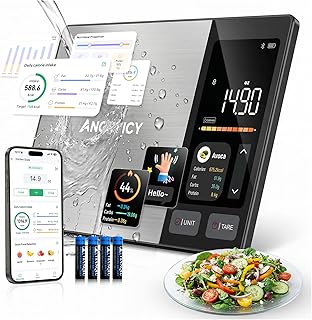 | Smart Food Scale Nutritional Calculator | Micronutrient Detail | 8.5/10 | Check price → |
 | Smart Nutrition Food Scale App | Keto and Fat Tracking | 8.2/10 | Check price → |
 | Etekcity Food Kitchen Scale | No-App Simplicity | 8.0/10 | Check price → |
Scroll sideways on small screens to see every column.
Etekcity Food Kitchen Scale Nutritional Calculator:
Smart Food Scale Nutritional Calculator:
Smart Food Scale Nutritional Calculator:
Smart Nutrition Food Scale App:
Etekcity Food Kitchen Scale:
Buying Guide: Accuracy, Nutrients, App Quality and Build
How accurate does a nutrition scale need to be for protein?
A 1 g resolution is the practical standard for macro tracking, and every pick here meets it. Protein targets in the 30 to 50 g range per meal mean a 1 g error moves your total by roughly 2 to 3 percent, which is inside normal day-to-day variance anyway.
Weight capacity matters more than people expect. All five scales top out at 11 lb, or about 5 kg. That's enough for a full meal-prep bowl, a bag of rice, or a whole chicken.
It is not enough for a suitcase or a toddler, and no kitchen scale should be asked to do that.
The step-up question is who does the arithmetic. If you're comfortable multiplying grams by a protein factor, the Etekcity Food Kitchen Scale costs the least and does the job cleanly. If you'd rather the number appear onscreen, the app-based picks handle it.
Which nutrients do you actually need tracked?
Calories, protein, carbs and fat cover most lifters. That's the baseline on every app-connected scale in this lineup. Beyond that, three nutrients come up again and again in real use: sodium, fiber and iron.
The 24-nutrient scale exists for that wider view. If you're watching blood pressure, managing iron intake, or eating plant-based and worried about hitting fiber targets, a broader panel beats a macro-only one.
Here's the honest catch. Any nutrient database is only as good as your entry. Weighing a chicken breast and logging it as skinless when it wasn't is a 40 to 60 calorie error, and no scale can catch that.
Food logging accuracy comes from what you select, not from the hardware.
Does the app matter as much as the scale?
Yes, and buyer feedback proves it. Every complaint pattern we saw across these listings centers on the app rather than the load cell: pairing failures after phone updates, database gaps, slow syncing. The physical weighing side is settled technology.
So weigh two things before buying. First, whether you'll realistically open an app after every portion. Second, whether a free app staying free matters to you, since a paywall appearing later would gut the value.
If your prep happens in a hurry, the color-display model keeps the critical numbers visible on the device itself, which is a small thing that saves time daily. For nutrition guidance behind the numbers, the USDA's FoodData Central is the public database most of these apps draw on.
Build quality, cleaning and battery life
All five are compact plastic-body scales with a tempered glass or plastic platform. None are dishwasher safe, and owners who report early failures almost always describe moisture near the buttons or a drop onto tile.
Battery life tracks directly with features. Bluetooth and a color screen draw more than a basic LCD, so app-paired models tend to need fresh batteries sooner. That's a fair trade, not a flaw, as long as you keep spares in a drawer.
One more practical point: keep your scale on a hard, flat surface. A wobbling cutting board or a soft mat introduces more error than the difference between a 1 g and 0.1 g readout, and it's the single easiest fix in this whole category.
Who Should NOT Buy Best Digital Kitchen Scales for Protein Meal Planning
A nutrition scale is the wrong purchase for a few kinds of buyers. Here's who they are, and what to look at instead.
You Need to Track Every Bite Away From Home
If most of your meals come from restaurants, cafeterias or takeout, a kitchen scale solves almost nothing. You can't weigh a burrito you didn't build, and guessing at portion weights adds noise rather than precision.
Look at portion-size references instead, like hand-size guides or a photo-based food log. Those tools estimate roughly, but they work everywhere. A scale is a home tool, and it stays home.
You Want a Body-Weight or Muscle Number
If your actual goal is tracking body composition or lifting progress, a kitchen scale won't tell you either one. It weighs food. It has no idea what your body is doing.
What you want is a consistent weigh-in routine plus a training log, not a more precise chicken breast. If you lift at home, the kit that fits a small space will move your numbers more than any scale upgrade.
You Prefer Eating Without Numbers
Some people genuinely do better with structured meals and no counting. If logging grams triggers stress or obsessive patterns, a nutrition scale can make things worse, not better.
That's not a failure of the product. It's the wrong tool for that person. A plate-based approach, like a palm of protein and a fist of vegetables per meal, works well and needs no batteries.
Our privacy practices explain how we handle reader questions if you want to ask about your own situation.
Final Verdict
The Etekcity Food Kitchen Scale with Nutritional Calculator remains the pick for most people. It weighs up to 11 lb, reads in 1 g steps, and turns those grams into calories and macros through a free app. That combination, backed by a 4.6-star owner track record, is why it sits first.
Want the wider nutrient panel? Get the 24-nutrient Smart Food Scale, accepting a slower setup in exchange for sodium, fiber and iron tracking.
Need a screen you can read at arm's length while prepping? The color-display model handles that. And if you'd rather skip apps entirely, the basic Etekcity scale does plain weighing with no pairing headaches.
Before you buy, though, read the section above on who shouldn't. If you eat out most days or you already know counting makes you miserable, none of these five is the right answer, and that's worth knowing before you spend anything.
FAQ
What's the best Digital Kitchen Scales for Protein Meal Planning overall?
The Etekcity Food Kitchen Scale with Nutritional Calculator. It combines an 11 lb capacity, 1 g readability and a free app that converts weights into calories and protein, which is the core job for macro tracking.
Is 1 g precision enough for protein portions?
Yes, for portions above roughly 20 g. A 1 g error on a 40 g protein serving is about 2.5 percent, which is smaller than the natural variation between two chicken breasts of the same labeled weight.
Do I need a nutrition app, or can I just weigh food?
You can absolutely just weigh food. Plenty of people track macros in a separate app they already trust, and the basic Etekcity scale pairs fine with that habit. The app only saves you the multiplication step.
Why do these scales stop at 11 lb?
That's the standard ceiling for compact kitchen models, around 5 kg. It's chosen because it keeps 1 g sensitivity affordable while covering any realistic food portion, including a full stockpot or a large batch of meal prep.
Will the app keep working without internet?
Weighing always works offline since it happens on the scale itself. Nutrient lookups generally need a connection the first time you add a food, so most people log new foods at home and rely on cached entries later.
Can I use one of these for coffee or baking?
Yes. The same 1 g precision that serves protein portions works for pour-over coffee and most baking. For espresso or yeast, you'd want 0.1 g resolution, which none of these five offer.

Similar Posts