Best Exercise Anatomy Charts for Strength Training
The best best exercise anatomy charts for strength training is the Workout Poster Home Gym 40×30 Strength, the only chart in this lineup that combines full muscle anatomy, a written workout routine and a bodybuilding guide on one 40 x 30 inch sheet. It suits a garage gym or spare room where you want a single clear reference instead of three.
Want something small enough to keep in a bag or on a shelf? The 6-Day Cycle Full Body Workout Plan gets you there at 8.5 x 11 inches, as long as you don't need detailed muscle artwork.
As an Amazon Associate, I earn from qualifying purchases.
This guide covers what listings usually skip: how far away each chart stays readable, which ones really need a frame, and who should avoid wall charts completely. That last group gets its own section below.
Everything here comes from current Amazon product data, manufacturer specs and each product's owner track record. We haven't handled these charts in a lab, so read it as research-led buying guidance rather than a hands-on test.
Quick Answer: The Best Exercise Anatomy Charts for Strength Training
The Workout Poster Home Gym 40×30 Strength takes the top spot because it does the most work on one surface.
- Workout Poster Home Gym 40×30 Strength (Best overall): Anatomy, routine and lifting guide on one wide sheet.
- 6-Day Cycle Full Body Workout Plan (Best compact daily plan): Letter-size laminated card for a six-day split.
- Muscle Groups & Workout Posters (Best anatomy detail): A 24 x 16.5 inch laminated muscle map.
- gisgfim 8PCS Workout Posters Home Gym (Best multi-pack): Eight charts covering several training styles at once.
- Mad Skills Exercise Encyclopedia XL (Best for exercise depth): A bound guide for strength and bodyweight work.
Thinking about a phone app or a personal trainer instead? Jump to Who Should NOT Buy below before you spend anything.
Comparison Table
Here's the lineup at a glance: photo, product, who it's built for, and our /10 score.
| Photo | Product | Best for | Score | Buy |
|---|---|---|---|---|
 | Workout Poster Home Gym 40×30 Strength | All-in-one garage gym wall chart | 9.1/10 | Check price → |
 | 6-Day Cycle Full Body Workout Plan | Small-space lifters following a split | 8.6/10 | Check price → |
 | Muscle Groups & Workout Posters | Learning muscle names and targets | 8.9/10 | Check price → |
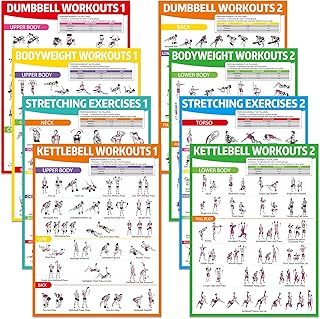 | gisgfim 8PCS Workout Posters Home Gym | Covering several training styles | 8.3/10 | Check price → |
 | Mad Skills Exercise Encyclopedia XL | Deep exercise reference at home | 8.7/10 | Check price → |
Scroll sideways on small screens to see every column.
Workout Poster Home Gym 40×30 Strength: Best Overall for Garage Gyms
6-Day Cycle Full Body Workout Plan: Best Compact Daily Plan
Muscle Groups & Workout Posters: Best Anatomy Detail
gisgfim 8PCS Workout Posters Home Gym: Best Multi-Pack for Variety
Mad Skills Exercise Encyclopedia XL: Best for Exercise Depth
Buying Guide: Size, Surface, Depth and What You Actually Need
A chart on the wall is a reference tool, not a coach. These five picks range from a letter-size laminated card to a 40 x 30 inch sheet and one bound book, so the real question isn't which is best, it's which one survives contact with your training week.
How big should an exercise chart be for a garage gym?
Bigger only helps if you can read it from where you actually stand. A 40 x 30 inch sheet like the Workout Poster Home Gym works because you can see the routine block from a rack two metres away. Put the same content at 8.5 x 11 inches and you'd need to walk over and pick it up.
The catch is wall cost. A 40 x 30 inch print eats roughly 0.77 square metres of surface, which is more than most people expect. If your setup is a corner of a bedroom, a 24 x 16.5 inch laminated chart like the muscle reference sheet is the realistic middle ground.
Laminated, paper or bound?
Readability fades. Durability doesn't.
Laminated charts resist sweat, chalk and the general damp of an unheated garage, and a quick wipe brings them back. Plain paper posters are lighter and cheaper but curl at the corners and stain faster. A bound guide like the exercise book sidesteps the wall entirely, though paper pages near a rack take a beating.
For reference, the U.S. Centers for Disease Control and Prevention notes that adults need at least 150 minutes of moderate-intensity activity weekly alongside two or more days of muscle-strengthening work, so whatever chart you pick should support a schedule you'll actually repeat.
Anatomy, routine, or both?
These are different jobs and most buyers only need one.
- Anatomy charts map muscles to movements. Best if you're learning what a lift targets.
- Routine charts like the six-day plan tell you what to do today. Best if you already know your way around a rack.
- Combined sheets and books do both, at the cost of fitting less of each.
If you're juggling which exercises to prioritise, our notes on common sticking points are a useful companion read.
How many charts do you actually need?
One good chart beats five mediocre ones. A multi-pack only wins when you genuinely want variety: different styles, different rooms, or a group setting. Owners of the eight-poster set tend to use two or three regularly and leave the rest rolled up.
Pick by what you'll look at every session, not by how many sheets fit in the box.
Who Should NOT Buy Best Exercise Anatomy Charts for Strength Training
Wall charts are the wrong purchase for three kinds of buyers. Here's who they are, and what to look at instead.
You Need a Program Built Around Your Goals
A chart shows options. It doesn't know your injury history, your squat depth, or how many days you can realistically train. The six-day cycle format suits someone with that schedule locked in, but if your week is unpredictable, a printed plan will just sit there.
Look for a coach, a reputable programming app, or a written plan designed around your available days instead.
You Train in a Gym, Not at Home
If you already train at a commercial gym, the movements you need are usually printed on the machines. A wall chart adds nothing except something to carry.
Spend on a session with a qualified trainer or a proper assessment instead. That's where the real return is.
You Want Instant Form Correction
A poster can't see your knees cave on a heavy set. Static artwork teaches what a muscle does, not whether you're doing it right.
If form is your bottleneck, a mirror plus a video check on your phone will do more than any chart on this list.
Final Verdict
The Workout Poster Home Gym 40×30 Strength wins because it does two jobs on one large surface. Anatomy, routine and a lifting guide on a 40 x 30 inch sheet means fewer glances at your phone mid-session.
Want something that fits a shelf, a binder or a shared flat? The 6-Day Cycle Full Body Workout Plan gives you a laminated, wipeable split at letter size, as long as you don't need muscle artwork.
Learning your anatomy first? The Muscle Groups & Workout Posters chart is the clearest muscle map here. And if you keep outgrowing posters, the Mad Skills Exercise Encyclopedia XL trades wall space for depth.
Before you buy, check the Who Should NOT Buy section above. If you train at a commercial gym or need real form feedback, none of these five is your answer.
FAQ
What's the best Exercise Anatomy Charts for Strength Training overall?
The Workout Poster Home Gym 40×30 Strength, because it covers muscle anatomy, a full body routine and a bodybuilding guide on one 40 x 30 inch sheet. It's the only pick here that answers both "what does this work?" and "what do I do next?" without a second product.
Are laminated workout charts worth it over paper ones?
Yes, if your setup is a garage, basement or any humid space. Laminated sheets wipe clean after a sweaty session and resist the dust that collects behind a rack. Paper posters are lighter and easier to hang, but corners curl and stain within a few months in a damp room.
Can a chart replace a personal trainer?
No. A chart tells you which muscles a movement targets and, in some cases, what to do on which day. It can't watch your bar path, adjust your depth, or spot a movement that's aggravating your shoulder.
Treat it as a reference, not coaching.
How high should I hang an exercise chart?
Around eye level while you're standing at the rack, so roughly 1.5 to 1.7 metres from the floor for most people. Higher and you're craning your neck between sets; lower and equipment blocks the view. Leave 30 to 40 cm of clearance from dumbbell racks.
Do anatomy charts help with muscle activation?
They help with intent rather than activation itself. Knowing which region a row targets lets you cue that area deliberately, which many lifters find improves how a movement feels. Verified buyer feedback on the anatomy-focused charts consistently mentions better focus during back and shoulder work.
What size chart is too small to be useful?
Anything below roughly 8 x 10 inches stops working as a wall reference. At that size you need to hold it in your hands, which defeats the point of hanging it. If wall space is tight, a letter-size laminated card kept on a shelf is the better compromise than a tiny poster nailed up high.

Similar Posts